Unscripted
A third-person detective game about reading a crime scene, questioning the people in it, and living with what you decide to believe.
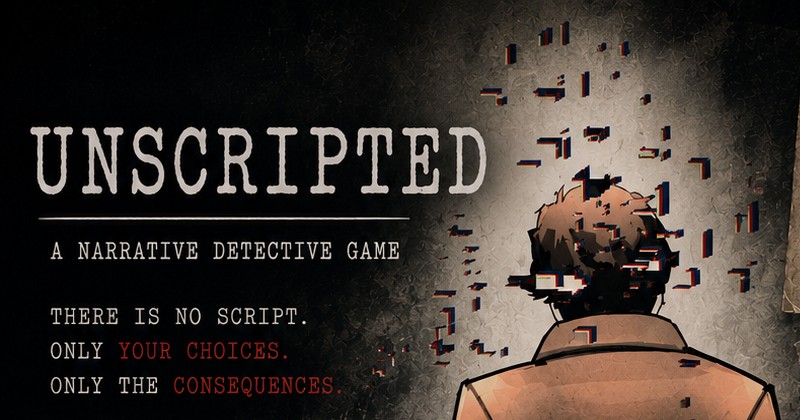
Unscripted is a third-person detective game built around investigation, interpretation and uncertainty. Players examine a crime scene, collect evidence and question suspects — but the game deliberately separates information from interpretation.
Finding a clue doesn't automatically reveal what it means. The player has to connect evidence, dialogue and behaviour before deciding what they believe.
Most investigation games turn discovery into confirmation: find an object, the game identifies it as a clue, the journal explains what it means, and the player moves on. Unscripted works differently.
Information is not the same as truth. The player receives evidence, but keeps the responsibility of interpreting it.
Investigation here is iterative — new evidence can change how a piece of dialogue reads, and dialogue can make an already-discovered clue suddenly matter more.
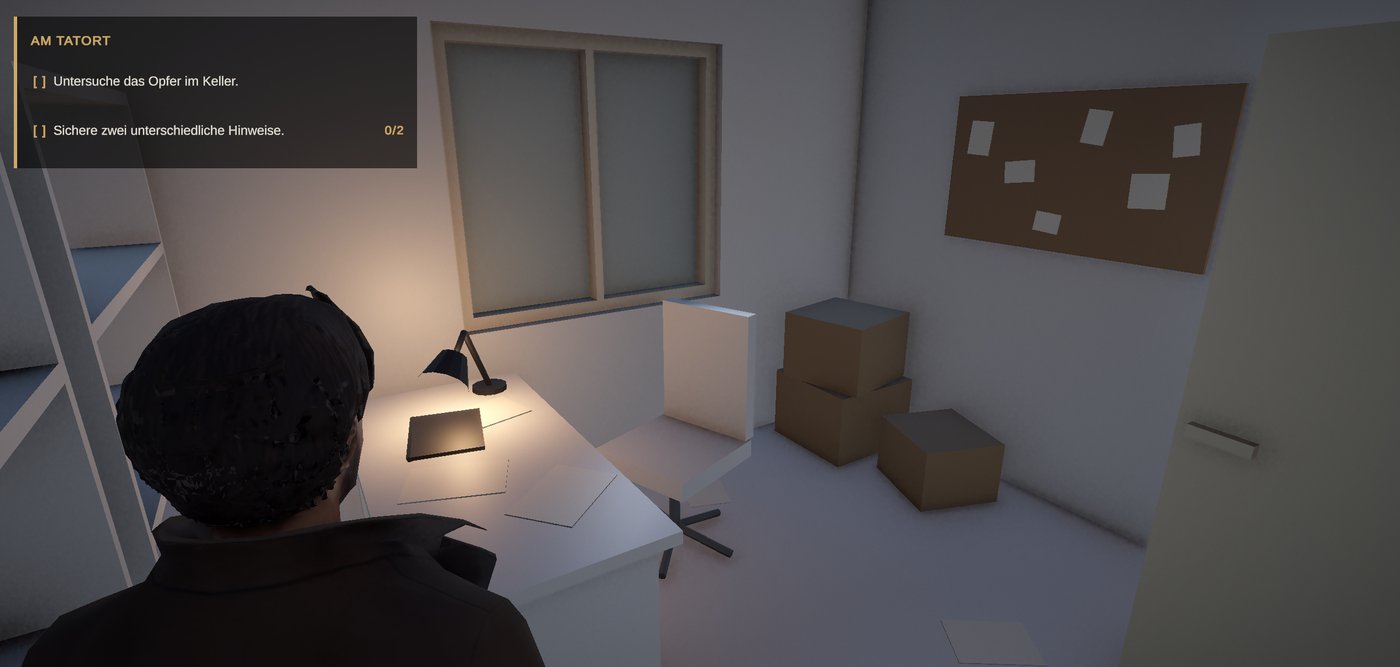
The player explores the environment looking for information that might matter — the space itself is a source of evidence, not just a backdrop. Interactable objects, an evidence corkboard, and a running objective list ("secure two different clues," for example) keep the investigation legible without walking the player through it.
The victim can be examined through dedicated inspection points rather than one generic "examine body" action. Three areas are set up as distinct inspection points, each tied to its own recorded clue — evidence the project currently tracks internally as Clue_Fingernägel, Clue_Headwound and Clue_Wristmarks.
Selecting an inspection point moves the camera to focus on that area and gives the player a contextual observation; anything found there can become part of the wider investigation.
Clues exist physically in the world before they exist anywhere else. Once the player finds and inspects one, the game records that discovery as its own clue state, which stays accessible afterward in the journal — implemented as individual entries (FoundClueEntry) rather than one flat list.
The journal is the player's external memory. It records what the player has found, not what they should believe about it — discovered evidence can also affect how later interrogation answers land, but the game itself never tells the player who's lying.
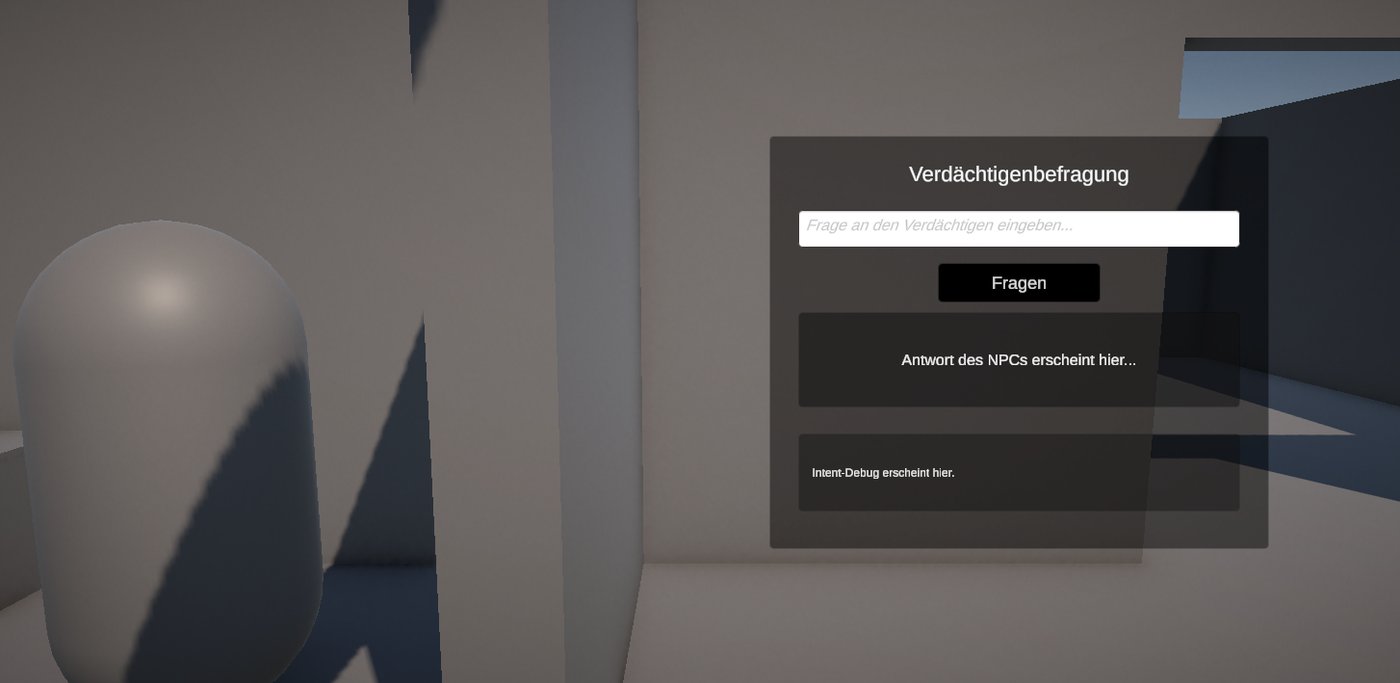
Suspects aren't questioned through a fixed list of dialogue buttons. The player types a question in their own words, and the game's intent-recognition system reads it, maps it to a topic, and routes it to the appropriate authored response — Jonas is the suspect this system was built and tested against first.
The design problem underneath that — ask the question, not the button — is how to let players feel like they're asking their own question while the dialogue itself stays inside authored narrative boundaries. The intent recognition runs locally, inside the project itself; it isn't calling out to an external AI service, and it isn't generating dialogue on the fly.
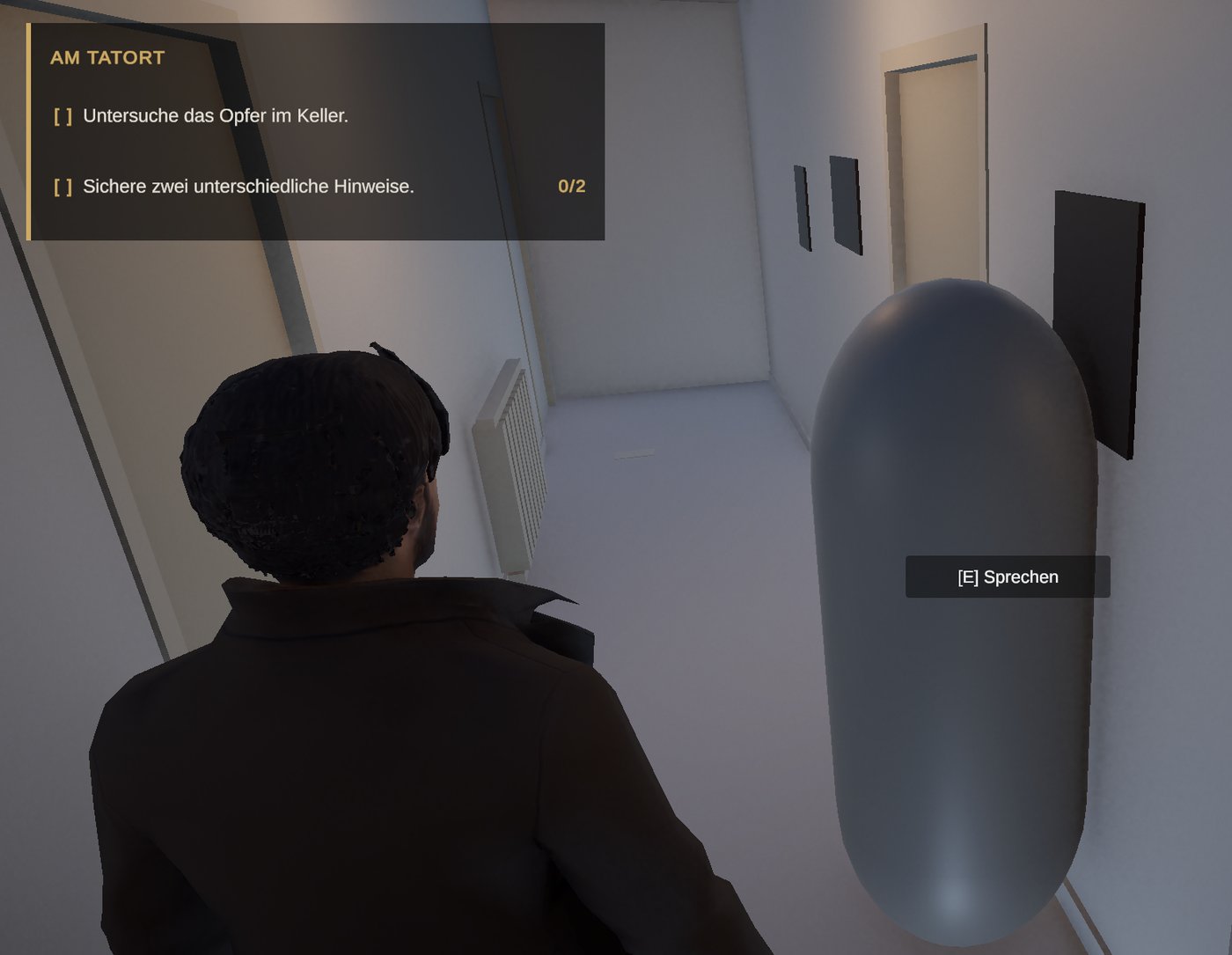
Starting a conversation also shifts the camera toward the suspect and hands control back to the player once it ends — a deliberate cue that the game has moved from free exploration into a different interaction state.
The main menu even ships with a dedicated Questions Cheat Sheet — a direct admission that free-form questioning needs a nudge sometimes, and a small piece of evidence that this system was actually tested on players, not just designed on paper.
Unscripted doesn't calculate the answer for the player. Reaching a conclusion means weighing physical evidence against suspect statements, noticing contradictions, and reading the environment and its context — the game keeps track of what's been found; deciding what it means is left to the player.
That gap, between what the player has discovered and what the player believes happened, is the core of the game's narrative design. The detective framing, the environmental storytelling, and the interrogation system all exist to feed that gap rather than close it for the player.
- Detective Narrative
- Environmental Storytelling
- Suspect Interrogation
- Evidence-Based Progression
- Player Interpretation
- Narrative Uncertainty
- Consequence
- Authored Dialogue
- Contextual Information
Alongside the investigation, Unscripted includes an early Haunt System — atmospheric, vision-like events layered on top of ordinary exploration. It's been built and visually tested, but it's still an experimental system rather than a finished, final mechanic, and its exact rules are still being worked out.
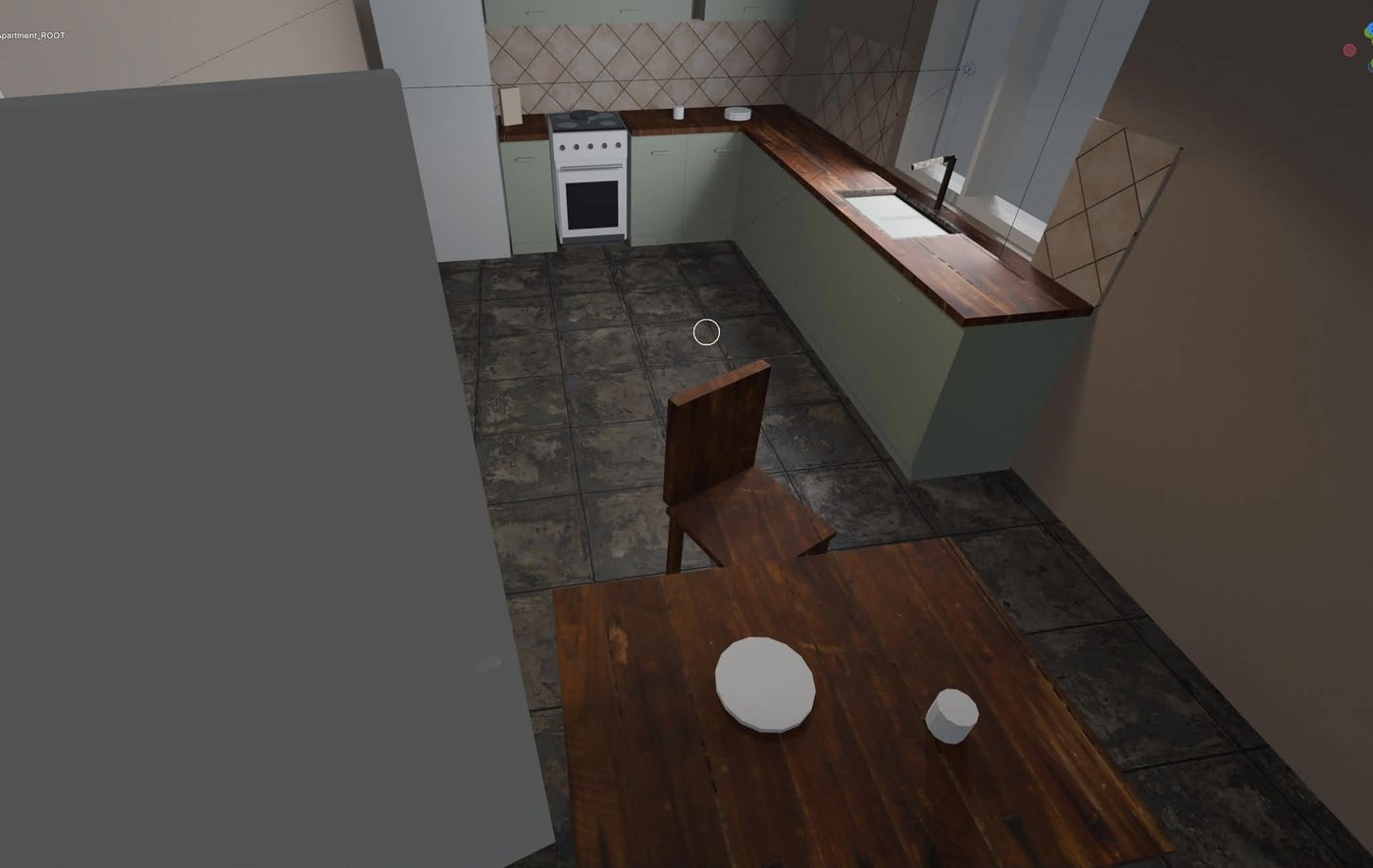
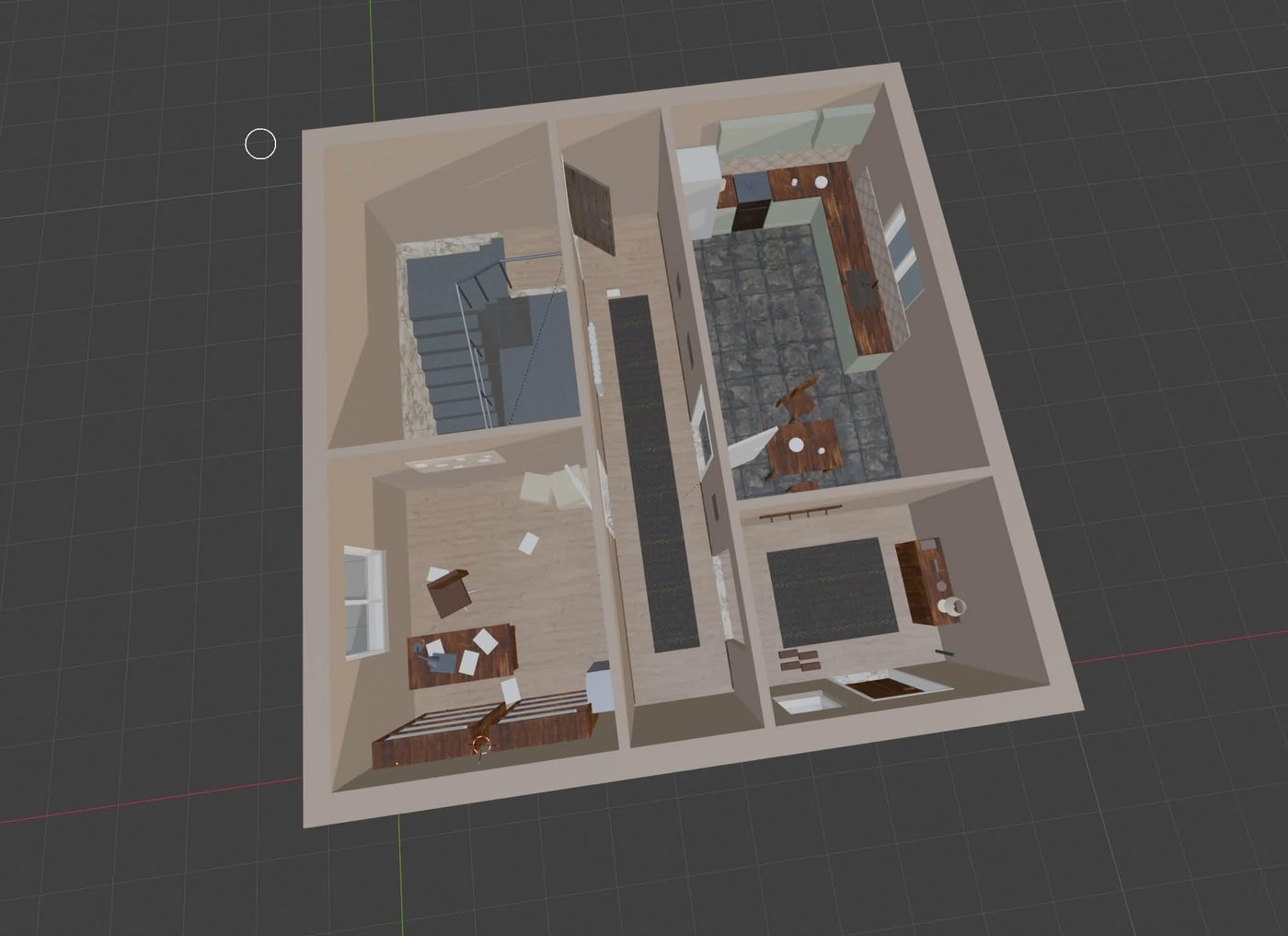
The playable space is an apartment — a hallway connecting a kitchen, a bedroom, a bathroom, and a staircase down to the basement, where the victim is found. Investigation and interrogation both happen inside this one space, so it has to support exploration and evidence-readability at the same time.
That means thinking about player movement, camera behaviour, sightlines to interactable clues, and interaction distance together — keeping the environment atmospheric without letting that atmosphere swallow the evidence the player is meant to notice, and keeping the camera from clipping through walls or looking outside the level entirely.
The interface work spans the dialogue and question-input screens, the journal and clue presentation, interaction prompts during exploration, and the main menu and pause menu — built to support the detective fantasy without turning into visual noise on top of it.

Audio was built into the experience rather than left out of the prototype — background atmosphere, sound on the start button and main-menu/pause interactions, and a full intro sequence with sound, including a self-recorded voice-over for that intro.
Built and iterated on directly inside Unity.
- Unity Engine
- C#
- Gameplay Systems
- Interaction Systems
- Third-Person Gameplay
- Camera Systems
- UI Implementation
- TextMeshPro
- Dialogue Systems
- NPC Interaction
- Investigation Mechanics
- Evidence / Clue Systems
- Inspection Systems
- Input Handling
- Scene Management
- Audio Integration
- Animation Integration
- Prefabs
- Colliders & Triggers
- Debugging
- Git-based Project Work
- Investigation vs. Interpretation
- How much information should the game hand over before it starts solving the case for the player?
- Free Input vs. Authored Narrative
- How can players ask their own questions while the dialogue stays controlled and narratively coherent?
- Camera vs. Interaction
- How should the camera move between exploration, body inspection and interrogation without losing the player?
- Information Persistence
- How should clues stay accessible in the journal without the journal turning into an automatic answer machine?
- Atmosphere vs. Readability
- How does a dark crime-scene environment stay atmospheric while the evidence inside it stays readable?
- 01 / Define
- Establish the detective fantasy, the player's role, and the design pillars.
- 02 / Systemize
- Translate investigation into interconnected mechanics rather than isolated features.
- 03 / Prototype
- Build the gameplay systems directly in Unity.
- 04 / Connect
- Integrate evidence, dialogue, camera, UI and narrative state with each other.
- 05 / Test
- Identify interaction, readability and technical issues.
- 06 / Iterate
- Refine the experience based on what testing surfaced.
Game design, systems design, narrative and interaction design, gameplay development, Unity implementation, UI/UX, level design, and prototyping and iteration.
- 01 / Systems Thinking
- Designing mechanics as interconnected systems rather than isolated features.
- 02 / Player Agency
- Giving players information without automatically interpreting it for them.
- 03 / Design + Implementation
- Translating design concepts into working Unity systems.
- 04 / Iteration
- Identifying interaction problems and refining the experience in response.
- 05 / Cross-Disciplinary Work
- Combining game design, narrative, UI, level design, audio and technical implementation.